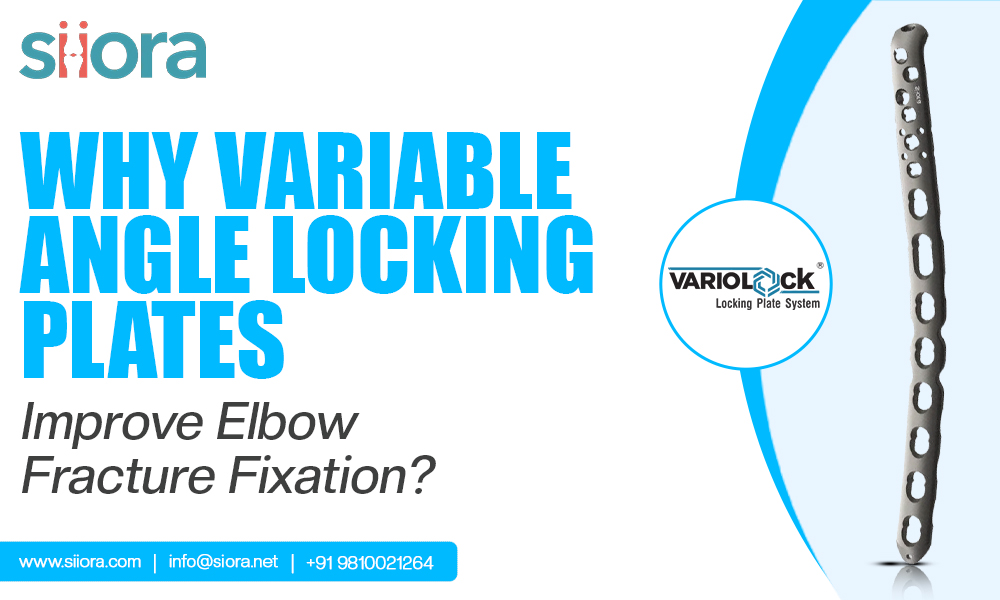
Elbow fractures can be difficult to treat because the joint has a complex structure and limited space for fixation. The distal humerus and surrounding bones form a joint that must allow smooth movement while also bearing daily mechanical stress. Even a small misalignment during fixation can affect elbow function and range of motion. Because of this, orthopedic surgeons often look for fixation methods that provide stability while allowing accurate screw placement. Variable angle elbow locking plate system has become an important solution in such situations.
What Are Variable Angle Locking Plates?
Variable angle locking plates are modern orthopedic implants designed to provide more flexibility during fracture fixation. Unlike traditional locking plates, which allow screws to be inserted only at fixed angles, variable angle systems permit screws to be placed within a certain angular range. This small design change gives surgeons greater control when stabilizing fractures around the elbow.
With this flexibility, screws can be directed toward stronger bone areas or specific fracture fragments. As a result, surgeons can achieve better fixation without compromising plate stability.
Better Adaptation to Complex Fracture Patterns
Elbow fractures often involve multiple fragments or irregular fracture lines. Fixed-angle plates sometimes make it difficult to capture smaller fragments because the screw direction is predetermined. Variable angle plates allow surgeons to adjust screw orientation according to the fracture pattern.
This flexibility helps in stabilizing fragments that would otherwise be difficult to secure. It also allows the implant to adapt better to individual patient anatomy, which can vary significantly from person to person.
Improved Stability and Fixation
One of the main advantages of variable angle plate system is the stability it provides. Once the screws are locked into the plate, the entire construct acts as a stable unit. This stability is especially important in distal humerus fractures where bone quality may be poor, particularly in elderly patients.
Because the screws can be angled toward denser bone regions, the fixation becomes stronger. This helps reduce the chances of screw loosening or fixation failure during the healing period.
Support for Early Rehabilitation
Stable fixation is important not only for bone healing but also for early joint movement. The elbow joint is prone to stiffness if immobilized for long periods. When fixation is strong and reliable, surgeons can often begin gentle rehabilitation earlier.
Early controlled movement helps maintain joint flexibility and improves the chances of restoring normal elbow function after healing.
Practical Advantages for Surgeons
Variable angle locking plates also provide practical advantages during surgery. The ability to adjust screw direction allows surgeons to avoid joint penetration and protect surrounding structures. This can be particularly helpful when working in a confined surgical field around the elbow.
Additionally, the design reduces the need for repeated screw repositioning, which can save operative time and minimize additional bone damage.
Conclusion
Variable angle locking plates have improved the way elbow fractures are managed. Their flexible screw placement, combined with strong locking stability, allows surgeons to achieve better fixation in complex fracture cases. By adapting to different fracture patterns and supporting early rehabilitation, these trauma implants contribute to more reliable healing and improved functional recovery. For many orthopedic surgeons, variable angle plating systems have become a valuable tool in elbow fracture fixation.
 trauma implants manufacturers