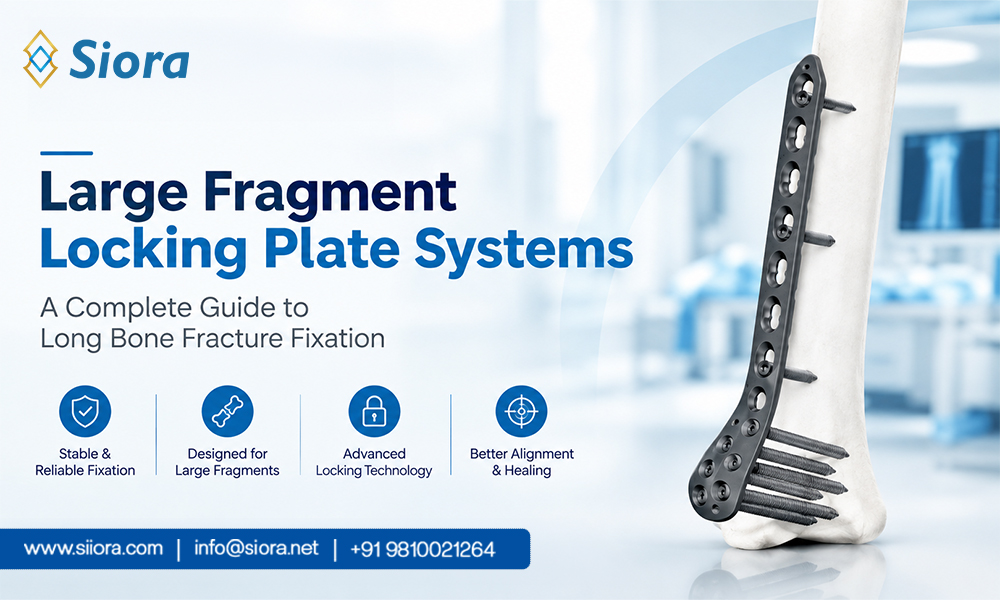
Long bone fractures can be challenging to manage, particularly when the injury involves multiple fragments, poor bone quality, or an unstable fracture pattern. In such cases, the choice of fixation system can have a major influence on fracture stability and the overall treatment approach. Large Fragment Locking Plate Systems are designed to provide stable fixation for fractures involving larger bones such as the femur, tibia, and humerus.
What Is a Large Fragment Locking Plate System?
A Large Fragment Locking Plate System is an orthopedic fixation solution that combines a strong plate with locking screws designed to engage securely with the plate. Unlike conventional plating techniques, where the plate is primarily pressed against the bone to create stability, locking technology allows the screw and plate to function as a fixed-angle construct.
This design can be particularly useful when stable fixation is required without excessive compression of the surrounding bone. The system is available in different shapes, lengths, and configurations to accommodate various fracture locations and anatomical requirements.
How Does Locking Plate Fixation Work?
The principle behind locking plate fixation is relatively straightforward. Locking screws thread into specially designed holes in the plate, creating a stable connection between the screw and plate. Once assembled, this construct can provide angular stability and help maintain the alignment of the fractured bone.
Because the plate does not have to be compressed tightly against the bone to achieve stability, the technique may help preserve the local biological environment around the fracture. This can be valuable when surgeons are aiming to support healing while maintaining reliable mechanical fixation.
What Are the Common Applications in Long Bone Fractures?
Large Fragment Locking Plate Systems are commonly considered for fractures involving major long bones. Depending on the specific design, they may be used for:
- Femoral fractures
- Tibial fractures
- Humeral fractures
- Comminuted fractures
- Metaphyseal and diaphyseal fracture patterns
- Fractures associated with compromised bone quality
- Certain revision and reconstructive procedures
The final implant selection depends on the fracture pattern, bone anatomy, soft-tissue condition, and the surgeon’s preferred fixation strategy.
What Are the Key Advantages of Large Fragment Locking Plates?
One of the main benefits of these systems is angular stability. Locking screws can create a rigid relationship between the plate and screws, helping the construct resist changes in alignment.
Other potential advantages include:
- Stable fixation: Helps provide structural support for complex fracture patterns.
- Fixed-angle stability: Locking screws can improve resistance to screw loosening and angular displacement.
- Versatile application: Different plate lengths and configurations can accommodate a range of fractures.
- Reduced dependence on bone-plate compression: The locking mechanism allows stability without relying solely on friction between the plate and bone.
- Useful in difficult bone conditions: Locking constructs can be considered when conventional screw fixation may provide limited purchase.
Factors to Consider During Implant Selection
Successful fracture fixation involves more than selecting a locking plate. Plate length, screw placement, fracture reduction, bone quality, and the overall fixation strategy all need careful consideration.
Surgeons also evaluate the anatomical contour of the plate and its compatibility with the fracture site. Appropriate surgical technique is essential to achieve the intended mechanical and biological objectives of the fixation system.
Supporting Reliable Fracture Fixation
Large Fragment Locking Plate Systems have become an important option in modern orthopedic trauma surgery. Their combination of plate strength, locking screw technology, and construct stability makes them suitable for many challenging long bone fractures.
Ultimately, the best fixation approach is determined on a case-by-case basis. Careful assessment of the fracture and appropriate implant selection can help surgeons establish stable fixation while supporting the natural healing process of the injured bone.

